
From Hidden to Visible: Working With (Not Against) Your Commitments
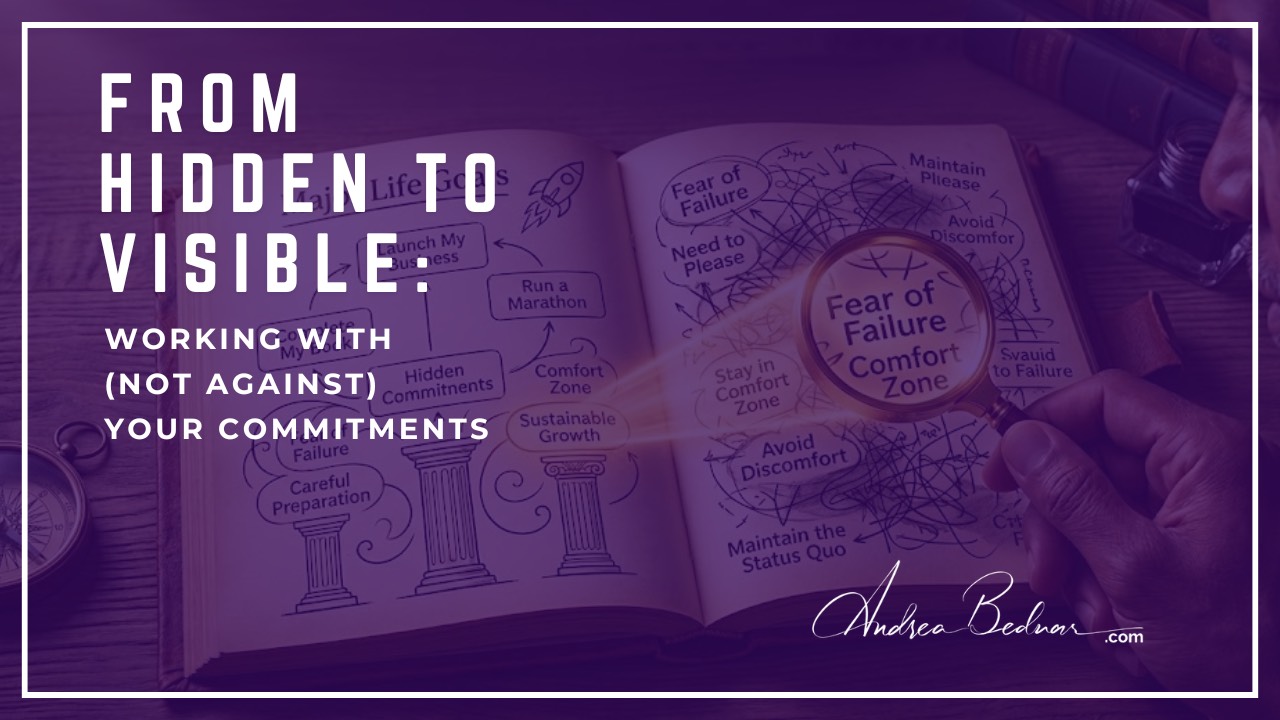
There's a version of you that already knows what needs to change.
You've probably named it before, maybe in a quiet moment, maybe in a frustrated one. The thing you keep saying you'll do differently. The pattern you've identified, the behavior you've committed to shifting, and the intention you've set more than once. And you're not wrong about any of it. You see the problem clearly. You understand what it costs you. You've made the commitment.
And yet, here you are again.
If that resonates — not because you're stuck, but because you're human — then what I want to talk about today might be the most important conversation you have this month.
Because the reason most people can't seem to get out of their own way isn't lack of awareness. It isn't lack of willpower. It isn't that they don't care enough, or that they need a better morning routine.
It's that they're working against a commitment they don't know they have.
The Commitment Beneath the Commitment
Here's what I mean: when someone tells me they're committed to developing their team but keeps micromanaging every decision, I don't see a contradiction. I see two commitments — one visible, one hidden — and both of them are real.
The visible commitment is the on they articulate. I want to develop my people. I want to trust my team. I want to delegate more effectively.
The hidden commitment is the one running in the background, mostly invisible, and often working overtime. Something like: I'm committed to making sure nothing fails on my watch. Or: I'm committed to being the most capable person in the room. Or: I'm committed to never being caught unprepared.
None of those commitments are wrong. None are a flaw of character. But when they run simultaneously with your stated commitment without being examined, they collide — and the hidden one almost always wins. Not because it's stronger, but because it's older. Because it's been working longer. Because at some point in your life, it kept you safe, successful, or both.
This is the thing most leadership development skips over entirely. We focus on the goal, the strategy, the new behavior. We build action plans around what we want to do differently. But the hidden commitments don't care about your action plan. They just keep running.
Until you see them.
Why Insight Isn't Enough
I spent years in EMS, and if that world taught me one thing, it's that knowledge and behavior are not the same thing. I've watched experienced providers freeze in situations they'd trained for hundreds of times. Not because they didn't know what to do — they absolutely did — but because their nervous system had a different plan, one built from repetition and experience that ran deeper than any protocol.
Leadership is no different.
Most leaders I work with are genuinely intelligent, self-aware people. They've read the books, been through the trainings, done the assessments. They know what they should do. And they still find themselves doing the thing they committed to stop doing, saying yes when they meant no, avoiding the hard conversation, overcommitting to control outcomes, replaying old reactions in new situations.
This is a competing commitment problem.
When you have a hidden commitment that runs counter to your stated goals, insight will get you started and then stall out. You'll see the pattern, name it, maybe even understand where it came from, and then find yourself back inside it three weeks later wondering what happened.
What happened is that you changed the surface without examining what's underneath.
What Gets in the Way Isn't Resistance — It's Protection
Here's a reframe that changes your entire perception.
The behaviors you most want to stop, the ones that feel like self-sabotage, the habits that don't make sense given how clearly you can see the problem — those aren't signs of weakness or inconsistency. They're signs that something is being protected.
When a leader avoids feedback conversations, they're not being cowardly. They're being faithful to a belief, usually one formed early and reinforced often, that says conflict is dangerous. Ot that their worth is contingent on being liked. Or that other people can't handle the truth without breaking.
When a high performer keeps taking on too much, they're not just bad at boundaries. They're likely holding a belief that says their value is conditional on their output. That slowing down means falling behind. that if they stop proving themselves, someone will finally notice they shouldn't be there.
These beliefs aren't irrational. They were rational. Once. They worked. And they've been operating as protective mechanisms ever since, long past the moment they stopped being necessary.
The work isn't to fight them. It's to see them clearly enough to make a new choice.
Making the Hidden Visible
This is the heart of what we do in the Get Out of Your Own Way program, which is built on the research and methodology developed by the brilliant folks at Minds at Work.
The process is structured, but it isn't complicated. What it requires is honesty, and a willingness to look at what you'd normally prefer to skip over.
You begin with what you say you're committed to. The goal, the change, the growth area — the thing that genuinely matters to you and that you haven't been able to consistently move toward. You name it as clearly as possible.
Then you name what you're actually doing instead. Not what you wish you were doing. Not what you plan to start doing. What's happening now.
Then you get curious about what that behavior is protecting. What would have to be true for that behavior to make complete sense as a strategy, even a flawed one? What are you avoiding? What are you afraid would happen if you changed it?
That's where the real commitment starts to appear. The one that hasn't been named, the one running quietly beneath every good intention you've tried to act on.
Once it's visible, it becomes workable. You can examine the beliefs underneath it. You can test whether they're still true. You can start to distinguish between what actually protects you and what only feels like it does.
And you can begin, slowly, to act from the commitment you actually want to be living.
This Is Not Accountability Culture
I want to be clear about what this isn't. This isn't about holding yourself to a stricter standard, or trying harder, or finally getting serious. Leaders who do this work aren't usually lacking in effort. They're often working twice as hard as the situation requires, precisely because the hidden commitment is demanding it.
This is about working smarter in the most literal sense. Working on the actual thing.
The reason this process is different from most change work is that it treats the obstacle as information instead of failure. The behavior you can't stop isn't evidence that you're broken. It's a clue about what you actually believe, and once you have that clue, you have something real to work with.
Most change efforts try to override the obstacle. This program brings it into the open.
And what becomes visible can be changed. What stays hidden keeps running the show.
INQUIRIES: To Begin Seeing What's Been Hidden
These aren't questions to solve. They're questions to stay with, ideally in conversation with someone you trust. Let them open rather than close. Notice where you feel defensive, avoidant, or quietly relieved.
Where am I working hard at a goal I haven't been able to move? What would an observer say that I'm doing or not doing?
or
What would I have to believe about myself, others, or the world for my stuck behavior to make complete sense as a strategy?
Sit with those. Let them be uncomfortable. That discomfort is usually the edge of something worth seeing.
ACTIONS: To Make the Invisible Visible
Choose one.
Name the Gap Without Judging It: Write down one commitment you hold — something you say matters to you and that you've been consistently falling short of. Don't explain it or defend it. Just name it, and then name what's actually happening instead. No commentary. Just the data.
Track One Pattern This Week: Pick one behavior you want to change and pay attention to the moments when it shows up. Don't try to stop it. Just notice what's happening right before it does — what you're thinking, what you're feeling, what you're afraid of. You're looking for the signal, not the solution.
Identify What the Behavior is Protecting: Take the behavior from the previous step and ask: What's the worst thing that could happen if I didn't do this? Let the answer be honest, even if it feels dramatic. That worst case is usually where the hidden commitment lives.
PRACTICES: To Build the Habit of Looking Honestly
Choose one and repeat it.
For the next three weeks:
Three times per week, before your first meeting of the day, write down a word that describes where you most want to lead from that day. At the end of the day, mark whether you did or didn't. No explanation required — just a yes or a no.
Or
Three times per week, deliberately do one small thing differently than you normally would in a low-stakes interaction — let someone else take the lead, stay quiet longer than feels comfortable, decline something minor. Notice what comes up when you break the pattern.
Getting Out of Your Own Way
Leadership isn't just about strategy and execution. It's about understanding the full picture of what's driving your behavior, including the parts that haven't been examined yet.
The leaders who make the most durable changes aren't the ones who tried hardest to overcome their obstacles. They're the ones who got curious about them, who looked at what was hidden until it wasn't hidden anymore, and who stopped fighting against a part of themselves that was, at some level, trying to help.
You don't have to be at war with yourself to grow.
You just have to start seeing clearly.
Click here for more information about how to Get Out of Your Own Way.
Alex Bednar is an Executive Coach specializing in Leadership Development. Connect with Alex at www.AndreaBednar.com for more insights on conscious leadership and operational excellence.
Stay connected with news and updates!
Join our mailing list to receive the latest news and updates from our team.
Don't worry, your information will not be shared.
We hate SPAM. We will never sell your information, for any reason.

